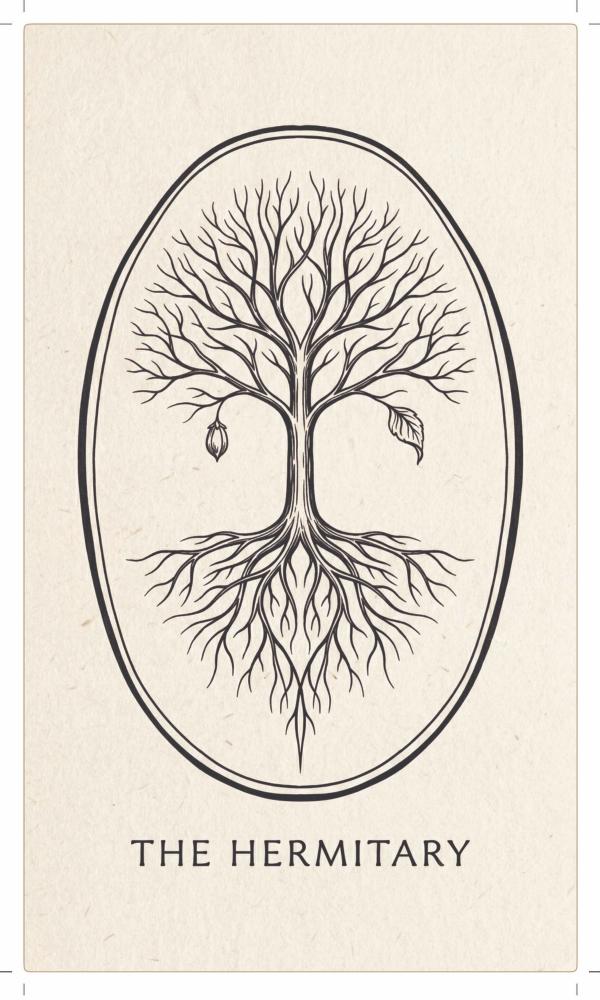
Thirty-six figures across twenty-five centuries who turned aside from the world’s noise to cultivate attention, place and vision.
Draw one card each morning. Read the name and the epitaph. Carry the figure with you through the day. In the evening, try its practice. Or browse the lives and let one catch your attention.
The Hermitary is a way of holding company with a long line of people, across cultures, centuries and continents, who chose attention over noise.
Draw a companion for the day, or browse all thirty-six lives below.
I·1 · SEED
The Choosing
Poet · recluse · chrysanthemum-grower · 365–427
Tao Yuanming
陶淵明
Chaisang, China
He put down the official seal and picked up a hoe.
"A heart that is distant creates a wilderness around it."
THE PRACTICE
The Small Refusal
Identify one thing you are expected to do this week that you will not do. Not out of laziness — out of fidelity. Write it down. Then do not do it. Observe what grows in the space it leaves.
The thread
Ji Kang (SEED) refused the court more spectacularly. Thoreau (SEED) made the same choice in a different forest.
A further line to carry
"I have built my hut among the throng of men, yet there is no noise of horse and carriage. A heart that is distant creates a wilderness around it."
Drinking Wine, No. 5
I·1 · SEEDTao Yuanming365–427 · Chaisang, China
He put down the official seal and picked up a hoe.
Poet · recluse · chrysanthemum-grower
"A heart that is distant creates a wilderness around it."
The Small Refusal
Identify one thing you are expected to do this week that you will not do. Not out of laziness — out of fidelity. Write it down. Then do not do it. Observe what grows in the space it leaves.
Ji Kang (SEED) refused the court more spectacularly. Thoreau (SEED) made the same choice in a different forest.
"I have built my hut among the throng of men, yet there is no noise of horse and carriage. A heart that is distant creates a wilderness around it."
He lived in a jar and told Alexander to move out of his light.
Cynic philosopher
"He has the most who is most content with the least."
The Bare Necessities Audit
Go to where you sleep. Remove everything except what you need for one night's rest. Sleep there. In the morning, write down what you missed. Write down what you did not.
Chōmei (SEED) also lived in a minimal container. Weil (YIELD) practised voluntary poverty.
"The purpose of wisdom is to illuminate human blindness, as the sun illuminates the world."
Diogenes Laertius
I·3 · SEEDJi Kang223–262 CE · Luoyang, China
He played the zither at the execution ground, and the music outlasted the dynasty.
Poet · musician · alchemist
"The Guangling San is now lost forever." — his last words, 262 CE
The Necessary Expression
What would you make, say, or play if you knew you would not be here tomorrow to explain it? Do that thing today — not for legacy, but for the act itself. No audience. No record.
Tao Yuanming (SEED) also refused the state, but quietly. Weil (YIELD) also faced power with stillness.
"He who is content with his lot in life, though he may be poor, is richer than any king."
Ji Kang's essays
I·4 · SEEDSimeon Stylitesc.390–459 CE · Near Aleppo, Syria
He built a column toward heaven and stayed there for thirty-seven years.
Ascetic · pillar-dweller
"He stood as a light upon a lampstand, a city on a hill." — Theodoret of Cyrrhus
The Small Elevation
Choose a place you can return to daily for one week — a chair, a stair, a windowsill. Go there at the same time each day. Stay for ten minutes. Do nothing. Let the place become a pillar.
Chōmei (SEED) also built a vertical dwelling. Hildegard (SEED) also lived in chosen enclosure.
"What is prayer? It is becoming still enough to hear what was always being said."
He climbed a mountain just to look down, and invented the view.
Poet · humanist · mountain-climber
"Men go abroad to wonder at the mountains, and pass by themselves without wondering."
The Ascent in Writing
Go somewhere high — a hill, a rooftop, an upper floor. Sit. Write a letter to yourself from that height. What does the view show you that the valley could not? Keep the letter. Open it when you next feel low.
Thoreau (SEED) also climbed mountains. Næss (SEED) also brought philosophy to a summit.
"Men go abroad to wonder at the heights of mountains, at the huge waves of the sea — and pass by themselves without wondering."
Confessions of Saint Augustine, cited 1336
I·6 · SEEDHildegard of Bingen1098–1179 · Rupertsberg, Rhine Valley
She saw flames descend, wrote them down, and planted a garden.
Abbess · composer · visionary
"I am the fiery life of the essence of God. I flame above the beauty of the fields."
The Listening Hand
Sit with a blank page. Ask: What wants to be written? Wait. When something stirs — even if it makes no sense — write it down. Do not judge it. Do this for ten minutes. You are not the author. You are the scribe.
Weil (YIELD) also practised radical listening. Bateson (FLOURISH) also saw pattern in the living world. Dickinson (ROOT) also wrote from enclosure.
"I am the fiery life of the essence of God. I flame above the beauty of the fields. I shine in the waters. I burn in the sun and the moon and the stars."
Liber Divinorum Operum, c.1170s
I·7 · SEEDKamo no Chōmei1155–1216 · Mount Hino, Japan
He built a hut ten feet square, and in building it, built a way of seeing.
Poet · monk · author of Hōjōki
"The river flows on unceasingly, yet the water is never the same."
The Ten-Foot-Square Description
Go to the room you are in. Walk to each wall, slowly. Touch it. Now sit. Write a description of this room as if it were the entire universe. Include the light, the sound of your own breath, what is missing.
"The river flows on unceasingly, yet the water is never the same. The bubbles that float upon the pools now vanish, now form again, never enduring long."
Hōjōki, 1212
I·8 · SEEDHenry David Thoreau1817–1862 · Concord, Massachusetts
He went to the woods to live deliberately, and came back with a book.
Writer · naturalist · tax-resister
"I went to the woods because I wished to live deliberately."
The Deliberate Morning
Wake before dawn. Go outside, or to a window. Watch the light arrive. Ask yourself: What is it I am actually doing with this life? Write the answer in one sentence. Read it again tomorrow.
Chōmei (SEED) built a smaller hut. Tao Yuanming (SEED) also farmed in retreat. Leopold (FLOURISH) also kept a phenological record.
"I went to the woods because I wished to live deliberately, to front only the essential facts of life, and see if I could not learn what it had to teach."
He built a hut above the tree line and called it his thinking-place.
Philosopher · mountaineer · founder of Deep Ecology
"The ecological self is not the narrow ego, but the self that realises its interconnection with all beings."
The Ecological Self
Go outside. Find something living — a tree, a weed, a bird. Spend five minutes widening your sense of self to include it. Write: Where do I stop and it begin? Then erase the boundary. Write what you feel.
Chōmei (SEED) also built a philosophy-hut. Leopold (FLOURISH) also extended ethics to land. Lovelock (YIELD) also looked at Earth from a distance.
"The ecological self is not the narrow ego, but the Self — with a capital S — that realises its deep interconnection with all beings."
Ecology, Community and Lifestyle, 1989
II·1 · ROOTHan Shanc. 9th century · Tiantai Mountains, China
He wrote poems on rocks and trees and left them for the weather to edit.
Hermit poet of Cold Mountain
"I climb the road to Cold Mountain, the road that never ends."
The Poem That Will Not Last
Write something you have been meaning to say — on a fallen leaf, in sand, in condensation on a window. Photograph nothing. Watch it fade. The poem is not the object. It is the act of writing it.
Du Fu (ROOT) also wrote in mountain solitude. Saigyō (FLOURISH) also wandered and wrote. Bashō (FLOURISH) followed these paths.
"I climb the road to Cold Mountain, the road that never ends. The valleys are long and deep, the peaks piled high. No one lives here."
Cold Mountain Poems, No. 1
II·2 · ROOTDu Fu712–770 · Kuizhou, Yangtze Gorges, China
He watched a dynasty fall from a thatched cottage and wrote it down, line by line.
Poet · chronicler of an age
"The country is broken, mountains and rivers remain."
The Witness in Your House
Sit at a window in your home. Look out. Write what you see — without metaphor, without judgment, without self. Just what is there. A car. A bird. A neighbour's light going on. Do this for five minutes.
Han Shan (ROOT) also wrote from a mountain, but turned away from the world. Dorothy Wordsworth (ROOT) also kept a daily record.
"The country is broken — mountains and rivers remain. In the city, spring — grass grows deep."
She wrote the world's first novel from behind a screen, and saw everything.
Novelist · diarist · lady-in-waiting
"The world of the Tale of Genji is more real to me than this one."
The Hidden Observation
Spend an hour in a public place. Do not read. Do not look at a screen. Watch. Later, write down three people you saw. Give each one an inner life you could not possibly know. This is the root of compassion, and of fiction.
Dorothy Wordsworth (ROOT) also kept a lifelong record of observation. Dickinson (ROOT) also wrote from a room.
"The hours of my life pass by like the waters of a flowing stream, and I long only for the world of the tale, which is more real to me than this one."
He never left his parish and became the father of ecology.
Naturalist · curate · letter-writer
"Nature is an inexhaustible fund of writing and discovery."
The Parish Walk
Choose a small area you think you know — a street, a park, a single block. Walk it as slowly as you can. Find something you have never noticed. Write it down in a letter to a friend who lives far away.
Clare (ROOT) also walked the same ground for a lifetime. Dorothy Wordsworth (ROOT) also journalled the near-at-hand.
"Nature is an inexhaustible fund of writing and discovery, and will supply us for ever with matter of admiration and wonder."
He knew the name of every flower, and when they felled the forest, he wrote it all down before it vanished.
Poet · farm labourer · enclosure's witness
"I am — yet what I am none cares or knows."
The Name-Keeper's Walk
Walk your neighbourhood. Find something that seems to be disappearing — a shop, a tree, a view, a sound. Write a short poem or paragraph that simply names what it is. Keep it. It is now recorded.
White (ROOT) also knew every species in his parish. Nan Shepherd (ROOT) also walked a local landscape into literature.
"I am — yet what I am none cares or knows; my friends forsake me like a memory lost."
I Am, c.1844
II·6 · ROOTDorothy Wordsworth1771–1855 · Grasmere, Lake District
She walked the same paths as her brother, and her journal was the root system.
Diarist · walker · witness
"We fancied the lake had floated the seeds ashore, and that a little colony had sprung up."
The Grasmere Journal Entry
Before bed tonight, write down everything you noticed today that you did not need to notice. The colour of the pavement. A bird on a wire. The way someone laughed. Do not interpret. Just record.
White (ROOT) also kept a parish journal. Clare (ROOT) also walked with fierce attention.
"When we were in the woods beyond Gowbarrow Park, we saw a few daffodils close to the water side. We fancied that the lake had floated the seeds ashore."
She never left her room and travelled further than anyone.
Poet · gardener · recluse
"The Soul selects her own Society — then — shuts the Door."
The Letter to the World
Write a short letter to someone you will never send it to. Tell them something true. Fold it. Tie it with thread. Place it in a drawer. You have written to the world. The world does not need to read it.
Murasaki (ROOT) also wrote from behind a screen. Vivian Maier (YIELD) also made an unseen archive.
"The Soul selects her own Society — Then — shuts the Door — To her divine Majority — Present no more —"
She walked into the mountain until the mountain walked into her.
Writer · walker · mountain-body
"To know the mountain one must go to it in the body."
The Body Walk
Go for a walk without a destination. Do not take a phone. Walk until you feel your body as part of the landscape. Stop. Stand still for five minutes. What does the ground know about you?
Bashō (FLOURISH) also walked into landscape. Thoreau (SEED) also walked daily, religiously.
"It is therefore more than surprising that until recently the mountain has been regarded not as a single entity but as two: a hill to climb, and a reservoir of water."
The Living Mountain, 1977
II·9 · ROOTR.S. Thomas1913–2000 · Llŷn Peninsula, Wales
He ministered to a stubborn Welsh congregation and wrote poems to God.
Poet · Anglican priest
"I have seen the sun break through to illuminate a small field for a while, and gone my way and forgotten it."
The Absence Prayer
Go to a quiet place — a room, a bench, a corner. Sit. Do not speak. Do not ask for anything. Simply hold the space open. If nothing comes, let nothing come. Stay for ten minutes. Write: What was the quality of that silence?
Dickinson (ROOT) also lived a life of inner weather. Weil (YIELD) also waited for God in absence.
"I have seen the sun break through to illuminate a small field for a while, and gone my way and forgotten it. But that was the pearl of great price."
The Bright Field, 1975
III·1 · FLOURISHSaigyō1118–1190 · Mount Kōya & Yoshino, Japan
He left the court, walked Japan, and taught the moon to follow him.
Poet-monk · wanderer
"To hide myself in the moon's light, I thought to become one with the darkness."
The Moon Walk
One night this week, go outside and walk under the open sky. Do not take a light. Let your eyes adjust. Find the moon, or a star, or the deepest dark. Walk for as long as you can without purpose. Let a single line arrive. Speak it aloud.
Bashō (FLOURISH) followed Saigyō's path centuries later. Han Shan (ROOT) also wrote poems while wandering.
"I wish to die beneath the cherry blossoms in spring, around the full moon of that second month."
Sankashū, c.1180
III·2 · FLOURISHMatsuo Bashō1644–1694 · Edo & the Narrow Road, Japan
He walked into the deep north and returned as a set of seventeen-syllable thresholds.
Haiku master · pilgrim
"The old pond — a frog jumps in — the sound of water."
The Haiku Walk
Walk until something stops you — a sound, a colour, a creature. Stand still. Let the moment form into three short lines in your mind: what is here, what it is doing, what it touches. Say it to yourself. Do not write it down. It belongs to the walk.
Saigyō (FLOURISH) walked these paths before him. Nan Shepherd (ROOT) also walked into landscape.
"The old pond — a frog jumps in — the sound of water."
Composed 1686; tr. Lafcadio Hearn
III·3 · FLOURISHGregory Bateson1904–1980 · Cambridge · Bali · Big Sur, California
He saw that the mind was not in the head, but in the circuit that includes the tree.
Anthropologist · ecologist of mind
"The unit of survival is the organism in its environment."
The Wider Mind
Sit near a tree, a plant, or a view of living things. Close your eyes. Breathe. Open your eyes and ask: Where does my thinking stop and this begin? Write down the boundary, then erase it with another sentence. Do this three times.
Margulis (FLOURISH) also saw symbiosis as the real unit of life. Varela (FLOURISH) also mapped the knowing body.
"The unit of survival is organism-plus-environment. The mind is not in the head; it is immanent in the whole system."
She proved that life advanced not by combat alone, but by merger.
Biologist · theorist of symbiosis
"Life did not take over the globe by combat, but by networking."
The Merger Meditation
Consider something you think of as separate from you — a person, an animal, a problem. Imagine your boundary dissolving into it. What would you learn if you merged instead of opposing? Write five minutes from the perspective of the merged entity.
Bateson (FLOURISH) also saw the organism-in-environment. Varela (FLOURISH) also studied the self-making cell.
"Life did not take over the globe by combat, but by networking. Bacteria merged to form complex cells. Cooperation is the rule."
Microcosmos, 1986
III·5 · FLOURISHFrancisco Varela1946–2001 · Santiago · Paris · Boulder, Colorado
He closed his eyes and watched the self dissolve, and called that science.
Biologist · philosopher · student of the embodied mind
"Lived experience is the starting point and the final court of appeal."
The Self-Experiment
Sit quietly with your eyes closed for ten minutes. Count your breaths. When a thought arises, note it — "planning," "remembering" — and return to breath. Afterward ask: Who was watching the thoughts? Write one paragraph.
Bateson (FLOURISH) also studied mind beyond skin. Margulis (FLOURISH) also studied the cell as self-making.
"Lived experience is the starting point and the final court of appeal. The mind is not in the head. It is enacted in the whole organism."
The Embodied Mind, 1991
III·6 · FLOURISHDonella Meadows1941–2001 · Cobb Hill, Vermont
She found the leverage points where a small nudge could change the whole system.
Systems thinker · farmer
"Without the systems way of seeing, we are blind to the most important properties of the world."
The Leverage Point Audit
Think of a system you are part of — your household, workplace, community. Draw a simple diagram of its main parts and flows. Now ask: Where is the smallest change I could make that might shift the whole? Circle that point. Try the change.
Leopold (FLOURISH) also thought in systems. Bateson (FLOURISH) also mapped feedback.
"The systems way of seeing is not better than the reductionist way. It is complementary. But without it, we are blind to the most important properties of the world."
Thinking in Systems, 2008
III·7 · FLOURISHAldo Leopold1887–1948 · Sand County, Wisconsin
He watched the green fire die in a wolf's eyes and spent the rest of his life rewriting ethics.
Ecologist · forester
"A thing is right when it tends to preserve the integrity, stability, and beauty of the biotic community."
The Land Ethic Extension
Walk your neighbourhood. Draw a circle on a map that includes your home and a patch of land you have never thought of as yours to care for. Go there. What does it need? Do one small thing for it.
Carson (FLOURISH) also shifted ethics through witness. Næss (SEED) also argued for the intrinsic value of all life.
"We reached the old wolf in time to watch a fierce green fire dying in her eyes. I realised then that there was something new to me in those eyes — something known only to her and to the mountain."
He followed the falcon through ten winters until his prose became flight.
Writer · peregrine-watcher
"I longed to be at the edge of things, to let the human taint wash away in silence."
The Single-Creature Watch
Choose one non-human creature you can observe. Watch it for fifteen minutes. Do not name it. Do not research it. Just watch. Write down only what it does. Let your prose follow its movements. Try to disappear.
Carson (FLOURISH) also wrote biology as literature. Leopold (FLOURISH) also tracked a single species.
"I have always longed to be a part of the outward life, to be out there at the edge of things, to let the human taint wash away in emptiness and silence."
The Peregrine, 1967
III·9 · FLOURISHRachel Carson1907–1964 · West Southport, Maine
She heard the silence before the spring came, and taught the world to listen.
Marine biologist · writer
"Those who contemplate the beauty of the earth find reserves of strength that will endure as long as life lasts."
The Small Sea
Find a patch of living ground — a puddle, a garden bed, a crack in the pavement with weeds. Sit or kneel beside it for ten minutes. Observe the life there as though it were an ocean. Write three sentences beginning: "No one told me..."
J.A. Baker (FLOURISH) also turned attention into literature. Leopold (FLOURISH) also sounded an ethical alarm.
"Those who contemplate the beauty of the earth find reserves of strength that will endure as long as life lasts. There is something infinitely healing in the repeated refrains of nature."
He gave away his inheritance, taught children in a mountain village, and built a house that was all silence.
Philosopher · teacher · hermit
"Whereof one cannot speak, thereof one must be silent."
The Ladder
Take a belief you hold strongly. Write it down in one clear sentence. Now write: "But what if I could not say this?" Sit with the silence that follows. For ten minutes, do not speak, even in your mind. What remains when the sentence is thrown away?
Weil (YIELD) also sought a silence beyond words. Rimbaud (YIELD) also stopped writing.
"My propositions serve as elucidations in the following way: anyone who understands me eventually recognises them as nonsensical — as steps — to climb up beyond them."
Tractatus Logico-Philosophicus, 6.54, 1921
IV·2 · YIELDSimone Weil1909–1943 · Paris · factory floors · London
She starved herself to match the suffering of occupied France, and her notebooks fed a century.
Philosopher · mystic · factory worker
"Attention is the rarest and purest form of generosity."
The Attention Exercise
Sit with another person — or with a difficult thought. For five minutes, empty yourself of opinions, responses, judgments. Simply attend. Ask nothing. When the five minutes end, write: What did I receive that I would have missed if I had been preparing my reply?
Wittgenstein (YIELD) also sought to clarify through silence. Hildegard (SEED) also waited for divine speech.
"Attention is the rarest and purest form of generosity. It is given to us to be able to give our attention to someone who is suffering."
He wrote all his poetry by twenty-one, then walked into Africa and never wrote another line.
Poet · wanderer · silence-keeper
"I made the whirling world stand still." — A Season in Hell
The Deliberate Silence
Choose something you are good at, something that has become part of your identity. For one week, do not do it. Do not tell anyone you are not doing it. Observe who you are without it. Write about that person. Or do not.
Wittgenstein (YIELD) also fell silent. Vivian Maier (YIELD) also made work never shown in her lifetime.
"I have embraced the summer dawn — and I have wept and trembled. I have made the whirling world stand still."
He walked into the snow on Christmas Day and was found there, where he had always been heading.
Writer · walker · wanderer
"I am not here to write, but to be." — attributed
The Walk Without Purpose
Go for a walk with no destination and no phone. Walk until the thinking stops. Notice when the body takes over. Turn toward whatever looks interesting without asking why. Return home by a route you have never taken. Write one sentence.
Rimbaud (YIELD) also walked away from his own legend.
"What I am is a walker, a dreamer, a loafer. I am not especially proud of this, but I accept it as my nature."
The Walk, 1917
IV·5 · YIELDVivian Maier1926–2009 · New York · Chicago
She took 150,000 photographs and showed them to no one. The archive found us.
Nanny · street photographer · invisible artist
"Nothing is meant to last forever. We have to make room for other people."
The Unshown Photograph
Today, make one thing — a photograph, a sentence, a sketch, a meal — that is only for you. Do not share it. Do not tell anyone you made it. Let the joy be entirely in the making. This is what freedom looks like.
Dickinson (ROOT) also made a vast body of work seen by almost no one. Rimbaud (YIELD) also left and never published again.
"Nothing is meant to last forever. We have to make room for other people. It is a wheel. You get on, you have to go to the end."
Recorded interview
IV·6 · YIELDPierre Teilhard de Chardin1881–1955 · Ordos Desert, China · New York
He saw the universe evolving toward consciousness, and the church forbade him to publish.
Jesuit priest · palaeontologist · cosmic mystic
"Love is the affinity which links and draws together the elements of the world."
The Cosmic Mass
Go outside. Find one physical thing — a stone, a leaf, a handful of soil. Hold it. Consider its history: the star that forged its atoms, the geological processes that shaped it. Say silently: This is my body. Feel no division between matter and meaning.
Thomas Berry (YIELD) continued Teilhard's cosmic story. Lovelock (YIELD) also saw Earth as a single entity.
"Love is the affinity which links and draws together the elements of the world, as it advances towards Spirit."
The Phenomenon of Man, c.1938–40
IV·7 · YIELDThomas Berry1914–2009 · Riverdale, Hudson River, New York
He said we needed a new story, and the old one was the universe telling itself.
Cultural historian · geologian
"The universe is a communion of subjects, not a collection of objects."
The New Story
Write a one-page story of how you got here. Begin with the Big Bang. Include the formation of Earth, the first life, the moment your parents met. End with you, reading this card. This is your cosmology. Keep it.
Teilhard (YIELD) provided the cosmic narrative Berry extended. Meadows (FLOURISH) also saw the need for paradigm shift.
"The universe is a communion of subjects, not a collection of objects. The natural world is not a resource; it is a community to which we belong."
He built a monastery for thinkers in the ruins of the counterculture, and called it Lindisfarne.
Cultural historian · poet
"We are the generation that must learn to see the whole."
The Lindisfarne Invitation
Think of someone who shares your deepest concerns but with whom you rarely speak. Write them a letter — real or unsent. Invite them not to agree with you, but to join you in asking the question. The question is: What is ours to do now?
Berry (YIELD) also called for a new cultural story. Bateson (FLOURISH) also founded a thinking community.
"We are the generation that must learn to see the whole — the generation that must not reduce the planet to an economy, or the cosmos to a machine."
He saw the Earth as a single living being, and built a detector to hear her breathe.
Scientist · inventor · Gaia theorist
"We are part of Gaia, not its rulers."
The Gaia Check
Go outside. Stand still. Take three slow breaths. With each breath, consider: the oxygen was made by plants. The temperature is held by a web of living and non-living systems. Ask: What am I breathing? Write one sentence.
Margulis (FLOURISH) co-developed Gaia theory. Carson (FLOURISH) also saw the planetary in the particular.
"The Gaia hypothesis: the Earth is a self-regulating system made up of all life and the rocks, air, and oceans. We are part of it, not rulers of it."
The Ages of Gaia, 1988
FOUR SUITS · NINE CARDS IN EACH
The Choosing
Seed
Figures who walked away and chose their ground. Draw when you face a threshold, a refusal or a beginning.
The Long Staying
Root
Figures who went deep into one place over decades. Draw when you need to slow down, or when you are already slow.
The Fruiting
Flourish
Those whose practice gave outward gifts: poems, science, ethics and care. Draw when something wants to come through you.
The Passing-On
Yield
The late work, the letting-go, what lasts. Draw when you are ending something, or ready to pass something on.
THE DECK · IN PREPARATION
Carry the company with you.
DIGITAL EDITION · COMING SOON
Print at home · £18
Planned suggested minimum contribution. All thirty-six cards as high-resolution print-ready files, with print-at-home guidance and a companion booklet.
PRINTED EDITION · COMING SOON
The full deck · £35
Planned suggested minimum contribution. Thirty-six cards on 350 gsm matte stock, a cloth pouch for fieldwork, a companion booklet and the digital files.
The physical and downloadable editions are being prepared. Register your interest and we can contact you when they are available; there is no payment or order at this stage.