ISSUE FOUR · DECAY AND RETURN · WEEK OF 19 OCTOBER 2026
What the Fallen Tree Remembers
Notes from Mossdale · Paul Clarke
The birches in Hensol Wood are turning to yellow coins. The bracken on the hill has gone the colour of a fox. The light comes late and leaves early. On Sunday the clocks go back, and by next week it will be dark at teatime.
Everywhere I look, things are letting go.
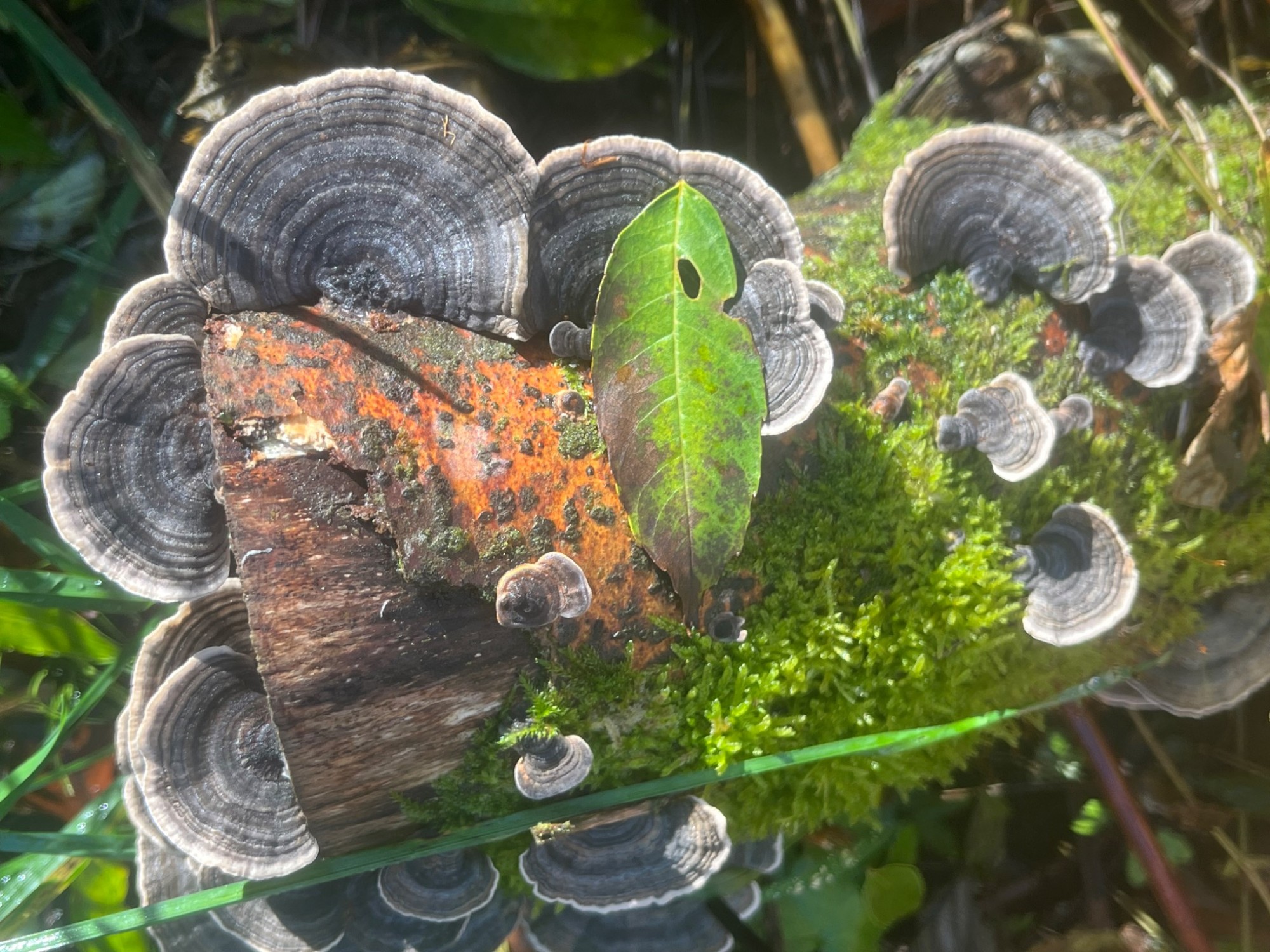
The leaves come down in the wind and lie in the wet. The summer growth is falling back into the ground. And on the fallen trunks in the wood, the fungi are fruiting. Brackets, crusts, small pale caps in the moss. This is their season. While everything else slows down, the rotters get to work.
Most of us were taught to see this as the end of the year. I have come to see it as the busiest part of it.
A study published this month puts this well. In Belgium there is a beech forest reserve that has been left alone since 1983. Nobody tidies it. Dead wood lies where it falls, more than 120 cubic metres of it on every hectare. A team of researchers took samples from 39 dead trees there and read the DNA of the fungi living in them. They found more than 2,300 distinct kinds.
Two findings stayed with me.
The first is that each tree carries its own nature into death. The kind of tree it was shaped which fungi came to it, more than which part of the tree the sample came from. The tree’s identity goes on mattering long after the tree has stopped growing.
The second is that the richest life was in the outer wood, the few centimetres nearest the air and the rain. Decay starts at the edge, where the dead wood meets the living world.
In the Naturally Smart method, the cycle of any community or project has six movements: Seeding, Roots, Branches, Flourishing, Yield, and Decay and Return. Every group I have worked with in 35 years has passed through all six. Most of us are good at the first four. We are poor at endings.
We keep things going long after their season. A committee meets because it has always met. A project limps on because no one wants to be the one to say it has finished. Or the opposite happens. Something stops suddenly, nobody marks it, and everything it held is lost. The skills scatter. The stories go untold. The trust built up over years drains away into nothing.
A healthy wood does neither. A fallen tree is not cleared away, and it is not propped up. It is allowed to lie. It is taken apart slowly by thousands of kinds of life and fed back into the ground. And because each tree carries its own nature into that process, each ending feeds something particular. An oak feeds what an oak can feed. A beech feeds what a beech can feed.
I think this holds for human things too. A good ending carries the character of what came before it. The way a group closes shapes what grows in its place. If it ends with care, with its story told and its lessons passed on, it becomes rich ground. If it is simply abandoned, it leaves very little behind.
The finding about the outer wood matters here as well. The work of return happens where the ending meets the living world. An ending kept private feeds nobody. An ending shared with the people around it feeds many.
I was raised a Catholic, and one line from the Gospel of John has stayed with me all my life. “Unless a grain of wheat falls into the earth and dies, it remains alone; but if it dies, it bears much fruit.” For a long time I heard it as a hard saying about sacrifice. Now, walking in the wood at this time of year, I hear it as a plain description of how the living world works. Something larger than us made it this way. Nothing that ends well is wasted.
A practice for this week
Find one fallen thing. A log, a stump, a drift of wet leaves under a tree. Sit or crouch beside it for ten minutes. Look closely at the surface, where it meets the air. Count the different kinds of life you can see: moss, lichen, fungi, beetles, woodlice, fine white threads in the wood.
Then think of one thing in your own life or work that has reached its end. A role, a habit, a group, a project. Write down three things it leaves behind that could feed what comes next. Then tell one person about them.
In the back end of the year, the wood is busy turning what has finished into what comes next. We can learn to do the same.
Sources
Dierickx, G., Vandekerkhove, K., Van de Kerckhove, P., Asselman, P. and Verbeken, A. (2026). “Tree identity shapes composition, substrate shifts dominance in deadwood fungi of an old-growth lowland beech forest.” IMA Fungus 17: e190198. doi:10.3897/imafungus.17.190198. Reported in: Deadwood Fungi Follow the Tree: Legacy Effects Persist as Logs Break Down (Bioengineer.org, 16 to 17 October 2026). Figures used: reserve unmanaged since 1983; over 120 m³ of dead wood per hectare; 39 trees sampled; 2,358 fungal “species hypotheses” (DNA-based kinds, so I wrote “more than 2,300 distinct kinds”); outer wood about 70% richer than inner wood.
Bible quote: John 12:24 (Revised Standard Version wording).
Clocks go back on Sunday 25 October 2026.