THE FULL PAPER · PAUL CLARKE
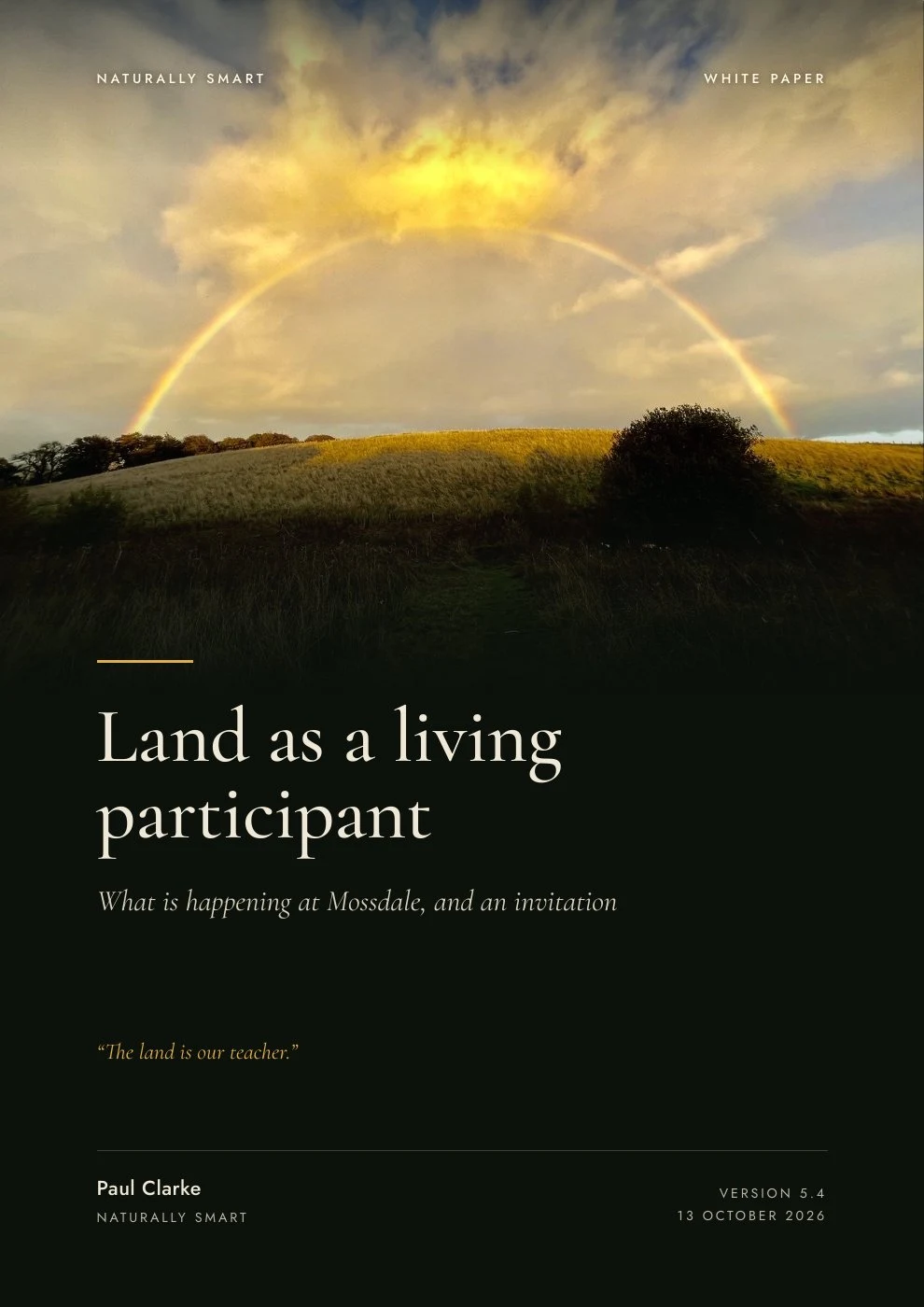
Land as a living participant.
What is happening at Mossdale, and an invitation.
The complete paper is below. Scroll to read each page, or open its text version.
Version 5.4 · 13 October 2026 · 14 pages
Read page 1 as text
N AT U R A L LY S M A R T
W H I T E PA P E R
Land as a living participant What is happening at Mossdale, and an invitation
“The land is our teacher.”
Paul Clarke N AT U R A L LY S M A R T
VERSION 5.4 1 3 O CTO B E R 2 0 2 6
Read page 2 as text
In brief In a small village in south-west Scotland, around eighty people are learning to treat the land as a living participant in their future. We sit in the wood until the birds come back. We grow food together. We gather at the fire as the seasons turn. We tell stories about the ground under our feet. We make music from the water in the wet ground. We look up at some of the darkest skies in Scotland, and we count the moths that fly beneath them. None of this began as a programme. It grew because people wanted it. This paper tells you what is happening, what we are learning, and what we would like to share.
1
The land is our teacher. It is alive and present, and we belong to it.
2
Contact comes first. A place to sit, bare feet in the earth and quiet company
3
Season and story hold a community together. People return for the turning
4
We make things together. Buildings, food, music and stories, made by many
5
This can happen anywhere. It needs a place, a fire, a few willing people and
Everything else follows from that.
at a fire do more than any explanation.
of the year and for the tales of their own place.
hands with what the land gives.
time. It does not need much money.
L A N D A S A L I V I N G PA R T I C I PA N T
2
Read page 3 as text
Breathe
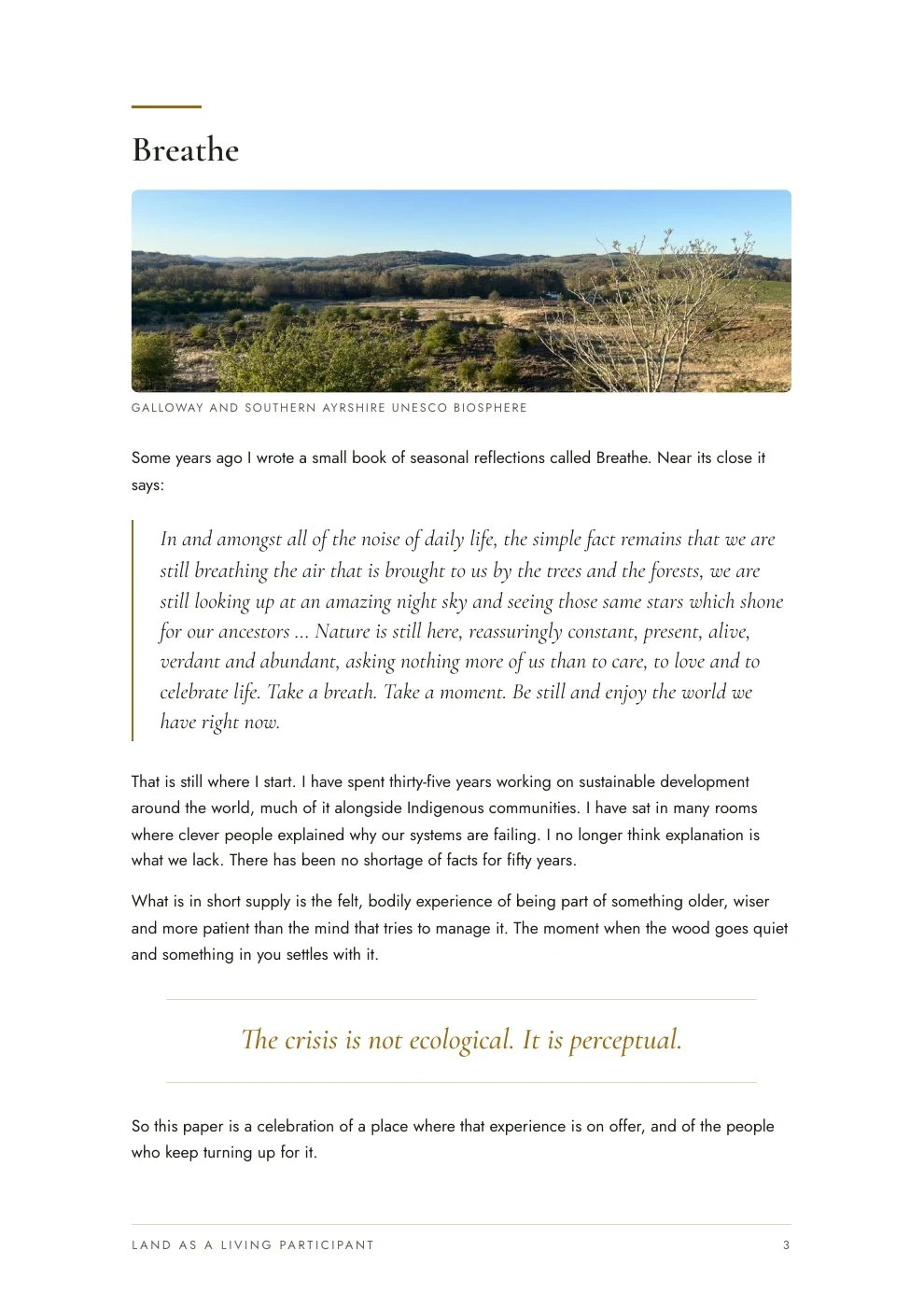
G A L L O WAY A N D S O U T H E R N AY R S H I R E U N E S C O B I O S P H E R E
Some years ago I wrote a small book of seasonal reflections called Breathe. Near its close it says:
In and amongst all of the noise of daily life, the simple fact remains that we are still breathing the air that is brought to us by the trees and the forests, we are still looking up at an amazing night sky and seeing those same stars which shone for our ancestors … Nature is still here, reassuringly constant, present, alive, verdant and abundant, asking nothing more of us than to care, to love and to celebrate life. Take a breath. Take a moment. Be still and enjoy the world we have right now. That is still where I start. I have spent thirty-five years working on sustainable development around the world, much of it alongside Indigenous communities. I have sat in many rooms where clever people explained why our systems are failing. I no longer think explanation is what we lack. There has been no shortage of facts for fifty years. What is in short supply is the felt, bodily experience of being part of something older, wiser and more patient than the mind that tries to manage it. The moment when the wood goes quiet and something in you settles with it.
The crisis is not ecological. It is perceptual. So this paper is a celebration of a place where that experience is on offer, and of the people who keep turning up for it.
L A N D A S A L I V I N G PA R T I C I PA N T
3
Read page 4 as text
The place is Mossdale, in Galloway, inside the Galloway and Southern Ayrshire UNESCO Biosphere. It is small and remote. Many of the people here are elderly. My home sits beside Hensol Wood: about 250 acres of old Atlantic woodland, with a barn, a polytunnel, a pond, hens and a fire that is lit often.
The sitting spot
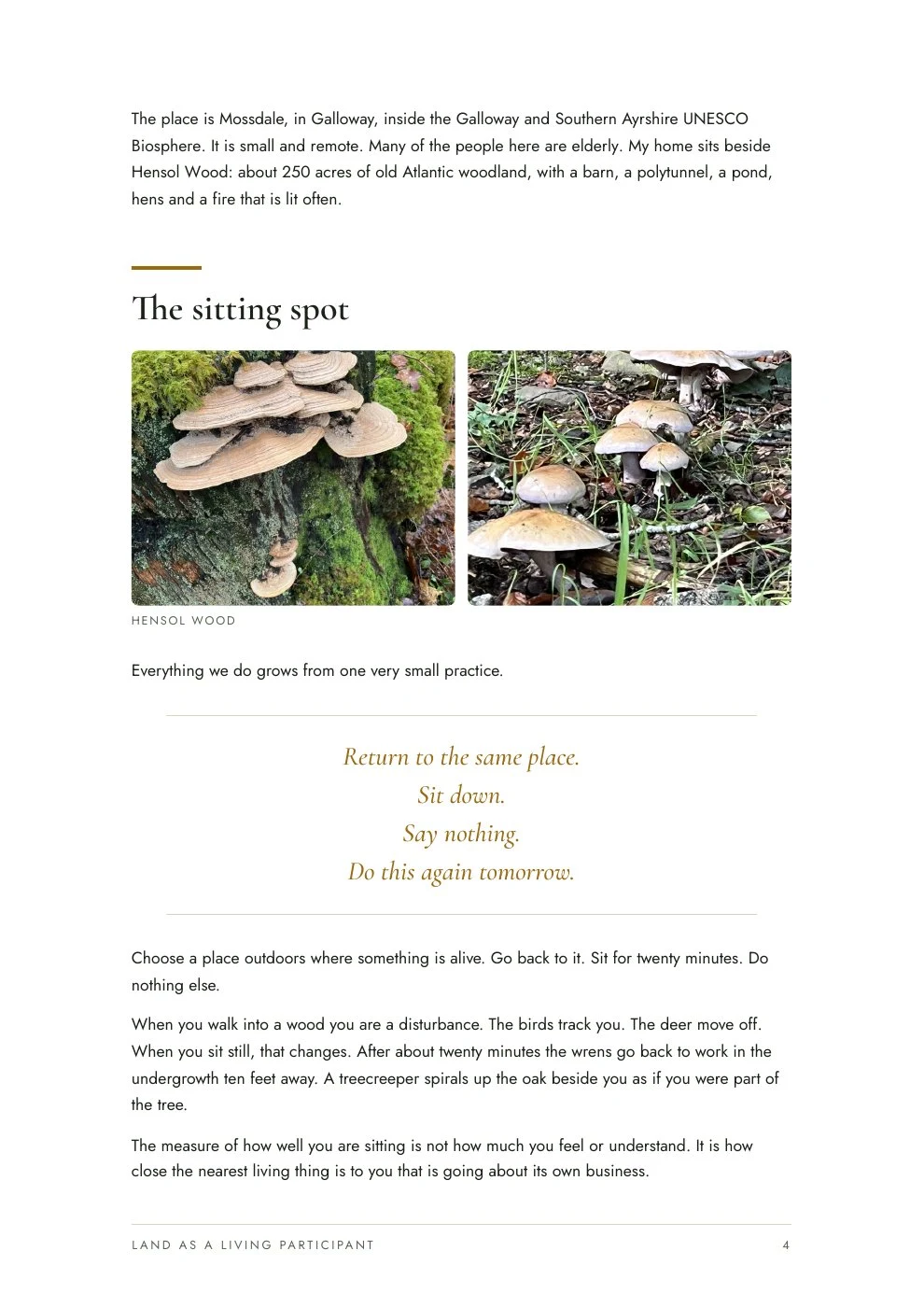
HENSOL WOOD
Everything we do grows from one very small practice.
Return to the same place. Sit down. Say nothing. Do this again tomorrow. Choose a place outdoors where something is alive. Go back to it. Sit for twenty minutes. Do nothing else. When you walk into a wood you are a disturbance. The birds track you. The deer move off. When you sit still, that changes. After about twenty minutes the wrens go back to work in the undergrowth ten feet away. A treecreeper spirals up the oak beside you as if you were part of the tree. The measure of how well you are sitting is not how much you feel or understand. It is how close the nearest living thing is to you that is going about its own business.
L A N D A S A L I V I N G PA R T I C I PA N T
4
Read page 5 as text
I have been coming back to the same wood for many years, in all weathers and at all hours. The wood is always slightly ahead of me. I hold what I have learned there as a starting point, not a scientific finding: the land is alive, it is present, and it takes part in what happens to us. Many of the oldest traditions on earth have always said so. I have often said that it is not that we leave the Earth; it leaves us. When we stop paying attention, the land goes quiet for us. The sitting spot shows the hopeful half of that sentence. When you turn up, slowly and regularly, the land turns towards you again.
Listening to the Land
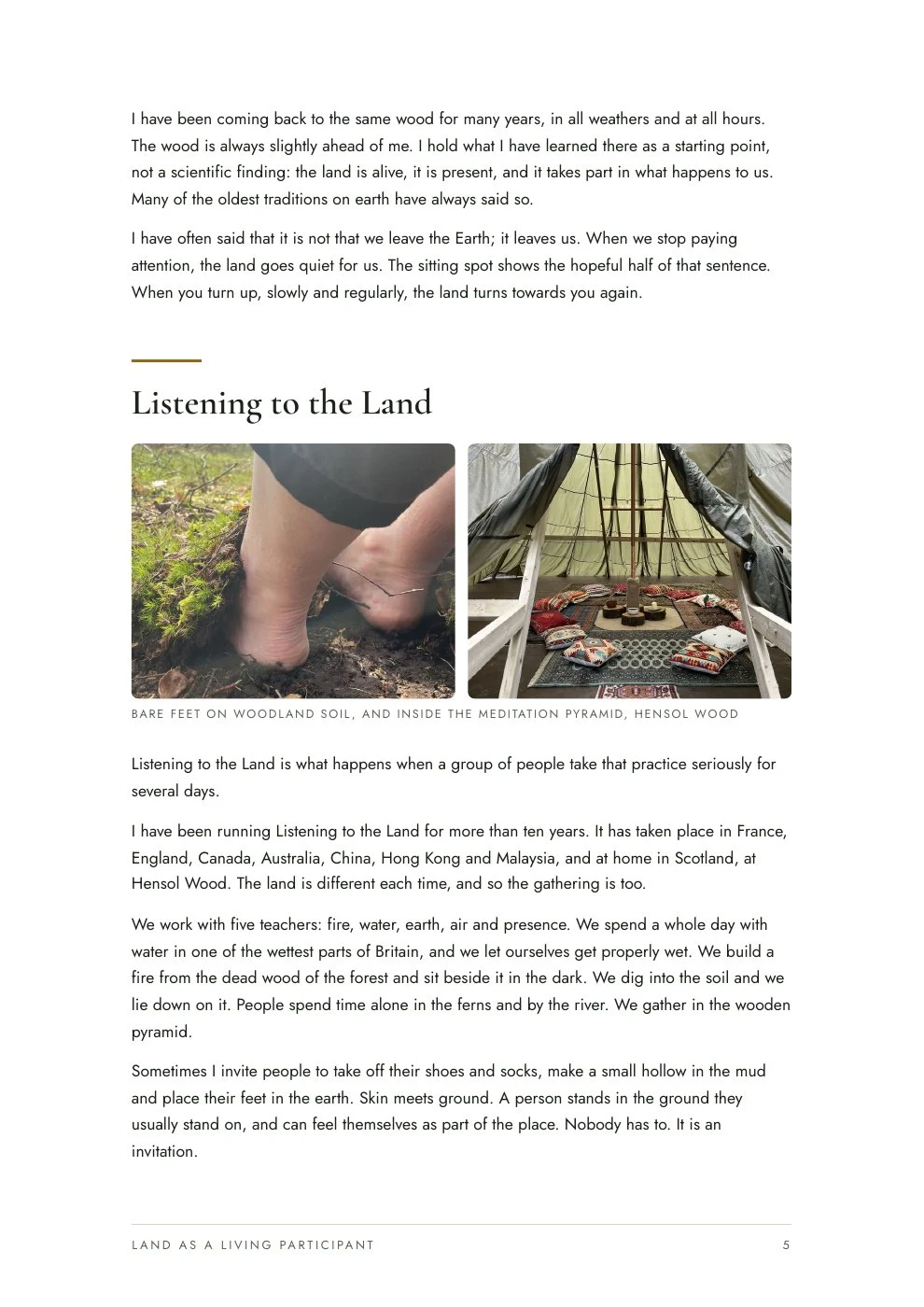
B A R E F E E T O N W O O D L A N D S O I L , A N D I N S I D E T H E M E D I TAT I O N P Y R A M I D , H E N S O L W O O D
Listening to the Land is what happens when a group of people take that practice seriously for several days. I have been running Listening to the Land for more than ten years. It has taken place in France, England, Canada, Australia, China, Hong Kong and Malaysia, and at home in Scotland, at Hensol Wood. The land is different each time, and so the gathering is too. We work with five teachers: fire, water, earth, air and presence. We spend a whole day with water in one of the wettest parts of Britain, and we let ourselves get properly wet. We build a fire from the dead wood of the forest and sit beside it in the dark. We dig into the soil and we lie down on it. People spend time alone in the ferns and by the river. We gather in the wooden pyramid. Sometimes I invite people to take off their shoes and socks, make a small hollow in the mud and place their feet in the earth. Skin meets ground. A person stands in the ground they usually stand on, and can feel themselves as part of the place. Nobody has to. It is an invitation.
L A N D A S A L I V I N G PA R T I C I PA N T
5
Read page 6 as text
Afterwards we sit together at the fire with tea. I do not ask people to explain what happened. They may not know yet. They may know and want to keep it. In that quiet company I often sense joy. People seem more at ease with themselves and with where they are. I tell everyone the same thing before they come. This is not always comfortable. Come ready to not know. Come ready to be changed by the land, and not merely informed by it.
The Turning Year
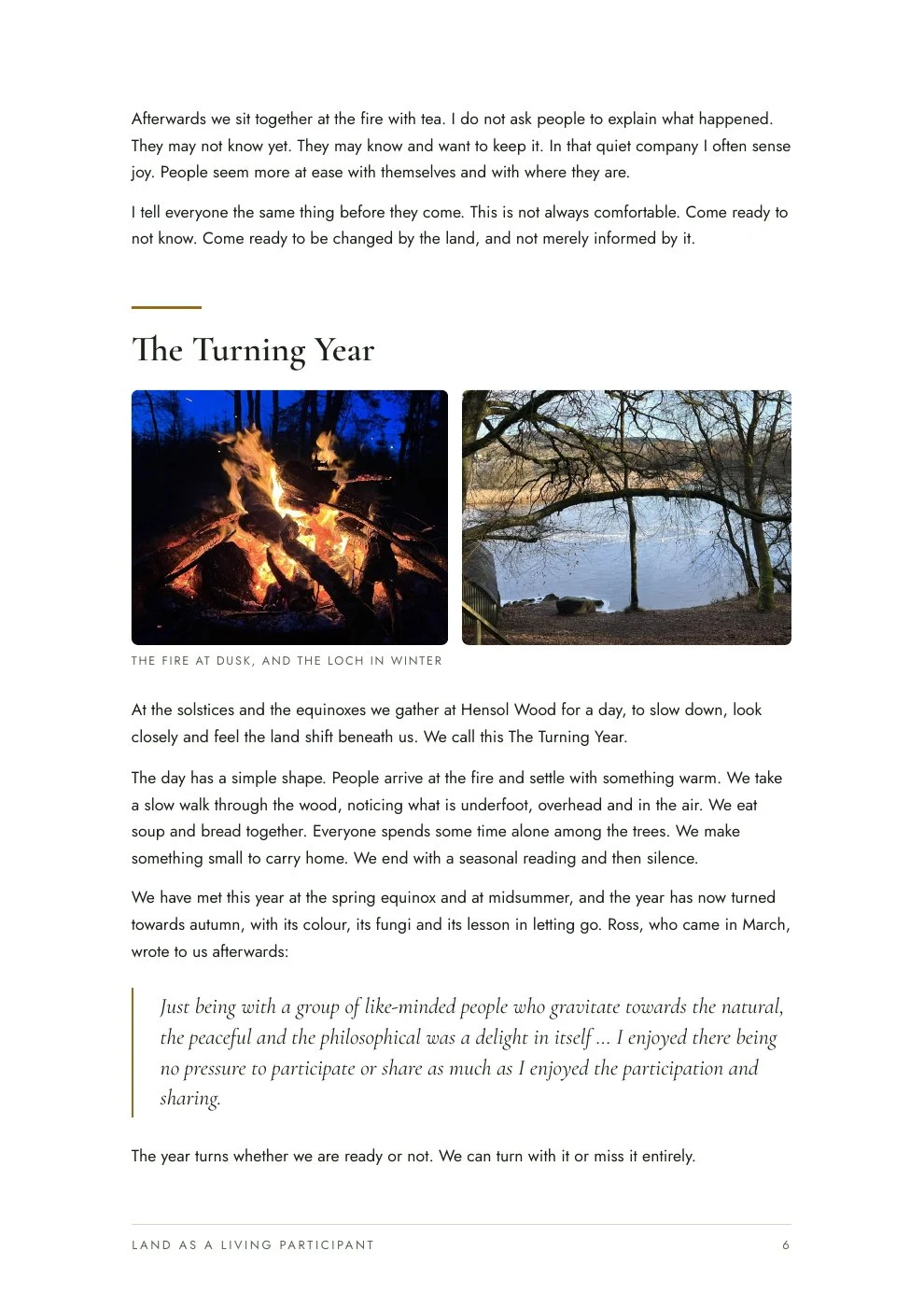
T H E F I R E AT D U S K , A N D T H E L O C H I N W I N T E R
At the solstices and the equinoxes we gather at Hensol Wood for a day, to slow down, look closely and feel the land shift beneath us. We call this The Turning Year. The day has a simple shape. People arrive at the fire and settle with something warm. We take a slow walk through the wood, noticing what is underfoot, overhead and in the air. We eat soup and bread together. Everyone spends some time alone among the trees. We make something small to carry home. We end with a seasonal reading and then silence. We have met this year at the spring equinox and at midsummer, and the year has now turned towards autumn, with its colour, its fungi and its lesson in letting go. Ross, who came in March, wrote to us afterwards:
Just being with a group of like-minded people who gravitate towards the natural, the peaceful and the philosophical was a delight in itself … I enjoyed there being no pressure to participate or share as much as I enjoyed the participation and sharing. The year turns whether we are ready or not. We can turn with it or miss it entirely.
L A N D A S A L I V I N G PA R T I C I PA N T
6
Read page 7 as text
Every gathering is free. Places are limited so that the day stays quiet. As a community interest company we hold everything we build for the benefit of the community.
Growing together
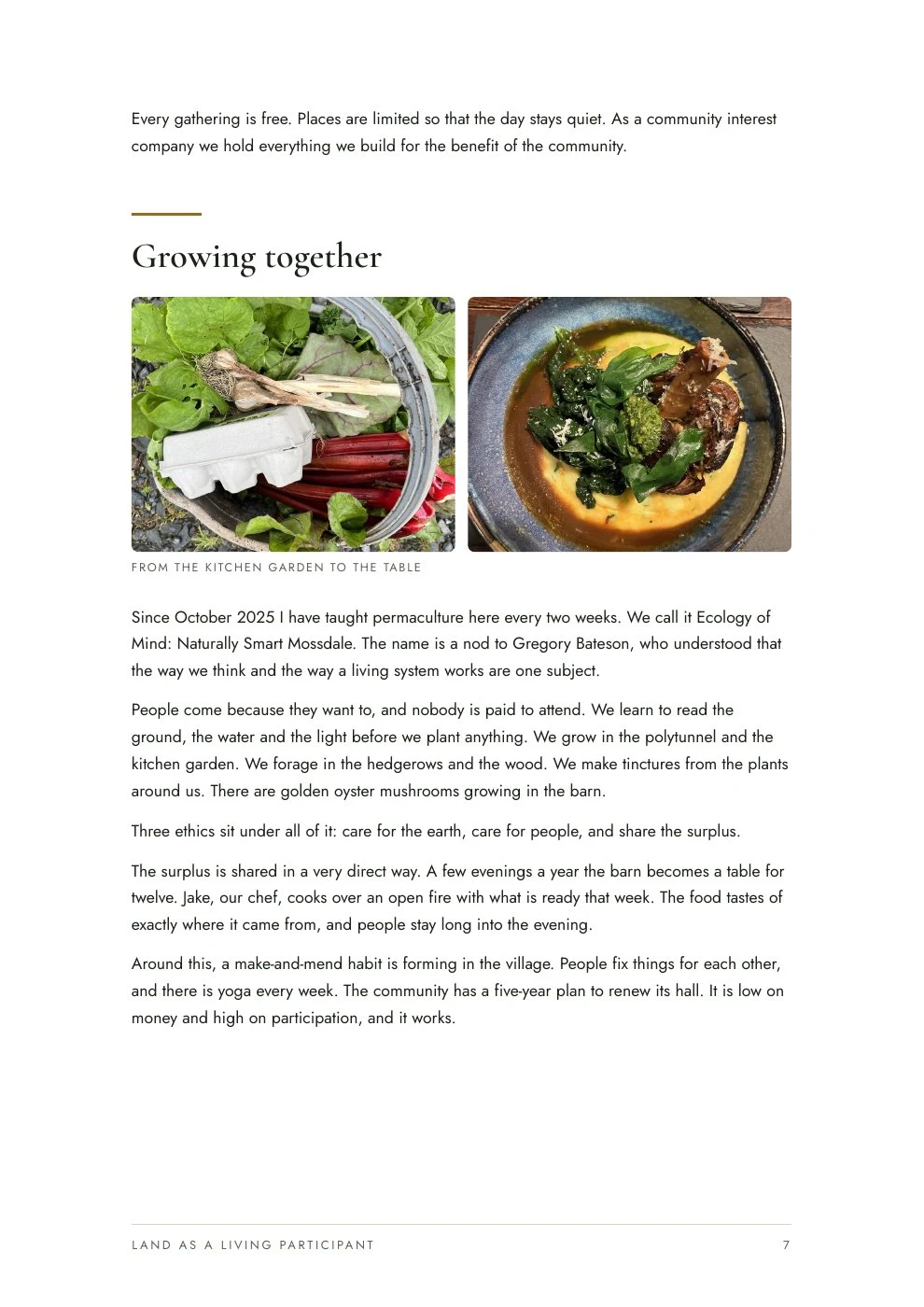
F R O M T H E K I TC H E N G A R D E N TO T H E TA B L E
Since October 2025 I have taught permaculture here every two weeks. We call it Ecology of Mind: Naturally Smart Mossdale. The name is a nod to Gregory Bateson, who understood that the way we think and the way a living system works are one subject. People come because they want to, and nobody is paid to attend. We learn to read the ground, the water and the light before we plant anything. We grow in the polytunnel and the kitchen garden. We forage in the hedgerows and the wood. We make tinctures from the plants around us. There are golden oyster mushrooms growing in the barn. Three ethics sit under all of it: care for the earth, care for people, and share the surplus. The surplus is shared in a very direct way. A few evenings a year the barn becomes a table for twelve. Jake, our chef, cooks over an open fire with what is ready that week. The food tastes of exactly where it came from, and people stay long into the evening. Around this, a make-and-mend habit is forming in the village. People fix things for each other, and there is yoga every week. The community has a five-year plan to renew its hall. It is low on money and high on participation, and it works.
L A N D A S A L I V I N G PA R T I C I PA N T
7
Read page 8 as text
Making together
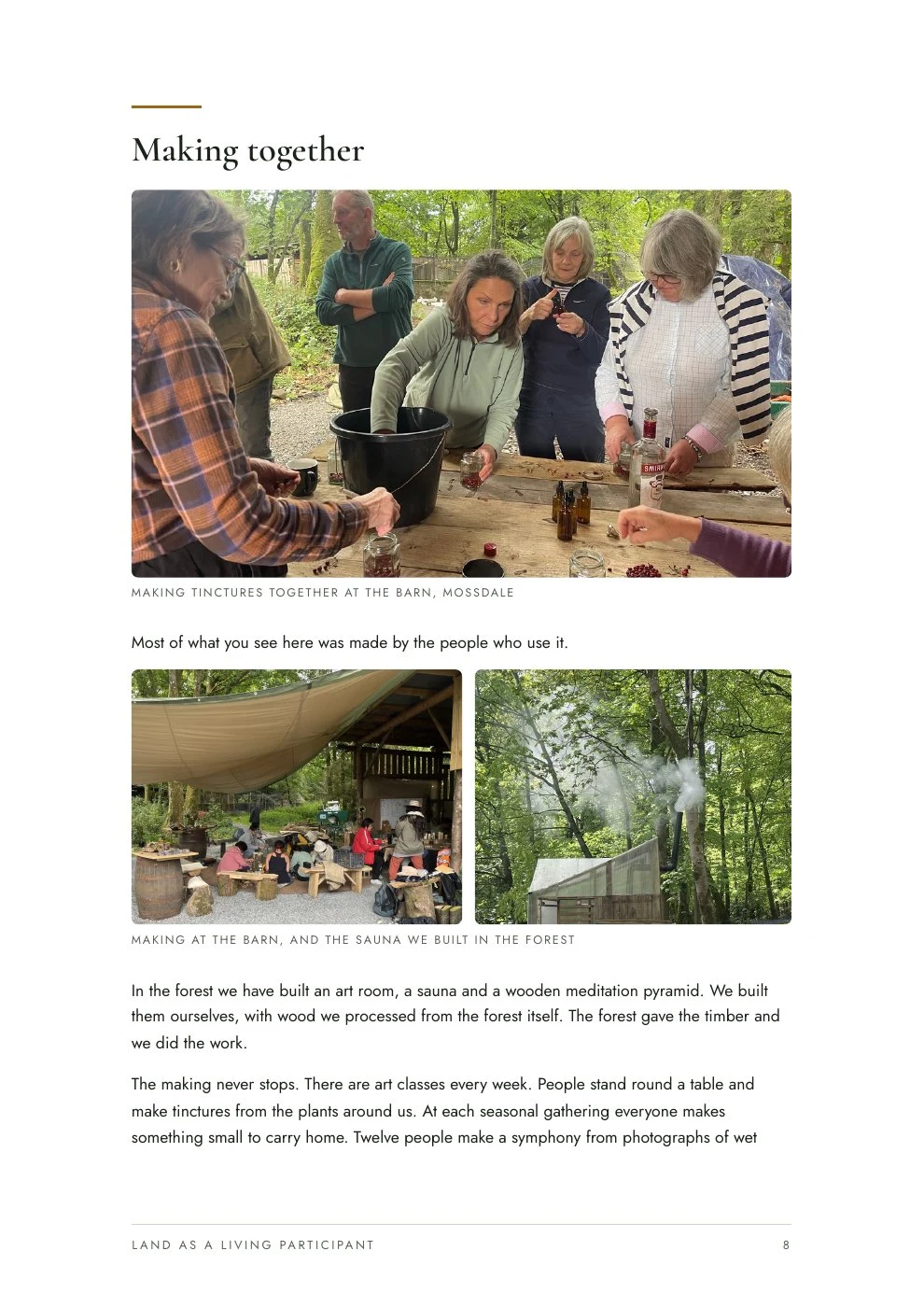
M A K I N G T I N C T U R E S TO G E T H E R AT T H E B A R N , M O S S D A L E
Most of what you see here was made by the people who use it.
M A K I N G AT T H E B A R N , A N D T H E S A U N A W E B U I LT I N T H E F O R E S T
In the forest we have built an art room, a sauna and a wooden meditation pyramid. We built them ourselves, with wood we processed from the forest itself. The forest gave the timber and we did the work. The making never stops. There are art classes every week. People stand round a table and make tinctures from the plants around us. At each seasonal gathering everyone makes something small to carry home. Twelve people make a symphony from photographs of wet
L A N D A S A L I V I N G PA R T I C I PA N T
8
Read page 9 as text
ground. A village makes a book of stories its own by listening to them together. A meal is made from what was grown and gathered that week. None of this is done to the land. It is done in the land and with the land, using what it offers. When people make something together with their own hands in a place, they begin to belong to that place, and to each other. That is what I mean by land as a living participant. The land is our partner in the making.
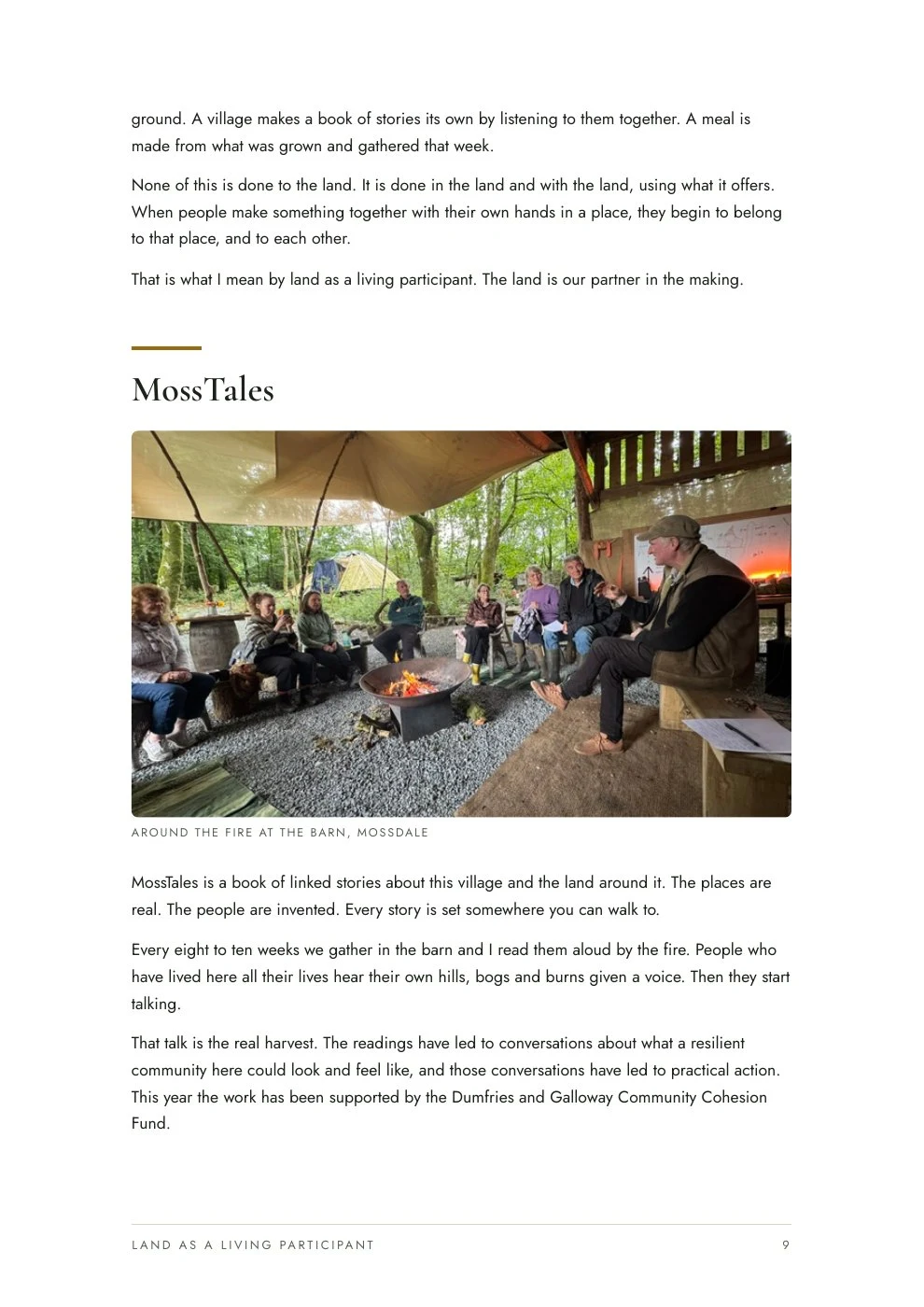
MossTales
A R O U N D T H E F I R E AT T H E B A R N , M O S S D A L E
MossTales is a book of linked stories about this village and the land around it. The places are real. The people are invented. Every story is set somewhere you can walk to. Every eight to ten weeks we gather in the barn and I read them aloud by the fire. People who have lived here all their lives hear their own hills, bogs and burns given a voice. Then they start talking. That talk is the real harvest. The readings have led to conversations about what a resilient community here could look and feel like, and those conversations have led to practical action. This year the work has been supported by the Dumfries and Galloway Community Cohesion Fund.
L A N D A S A L I V I N G PA R T I C I PA N T
9
Read page 10 as text
In the first book the land watches. In the second, which I am writing now, the land listens, and it keeps what it hears. A friend from the South Sámi tradition, Jerker Bexelius, gave me a line I carry everywhere: place without story is not heritage. MossTales is how this place is getting its story back.
Bog Symphony and the Land of Giants
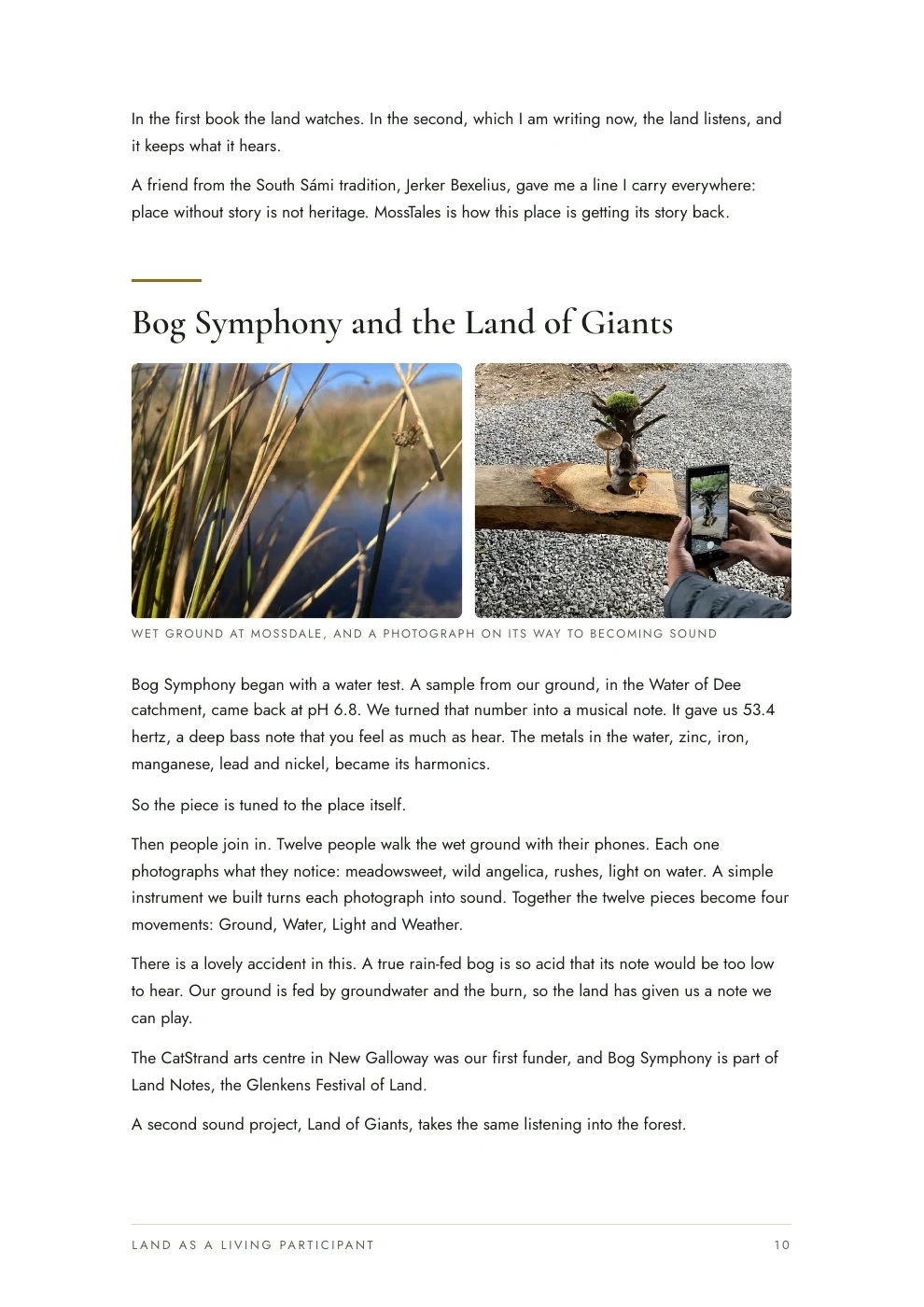
W E T G R O U N D AT M O S S D A L E , A N D A P H O TO G R A P H O N I T S WAY TO B E C O M I N G S O U N D
Bog Symphony began with a water test. A sample from our ground, in the Water of Dee catchment, came back at pH 6.8. We turned that number into a musical note. It gave us 53.4 hertz, a deep bass note that you feel as much as hear. The metals in the water, zinc, iron, manganese, lead and nickel, became its harmonics. So the piece is tuned to the place itself. Then people join in. Twelve people walk the wet ground with their phones. Each one photographs what they notice: meadowsweet, wild angelica, rushes, light on water. A simple instrument we built turns each photograph into sound. Together the twelve pieces become four movements: Ground, Water, Light and Weather. There is a lovely accident in this. A true rain-fed bog is so acid that its note would be too low to hear. Our ground is fed by groundwater and the burn, so the land has given us a note we can play. The CatStrand arts centre in New Galloway was our first funder, and Bog Symphony is part of Land Notes, the Glenkens Festival of Land. A second sound project, Land of Giants, takes the same listening into the forest.
L A N D A S A L I V I N G PA R T I C I PA N T
10
Read page 11 as text
Dark skies
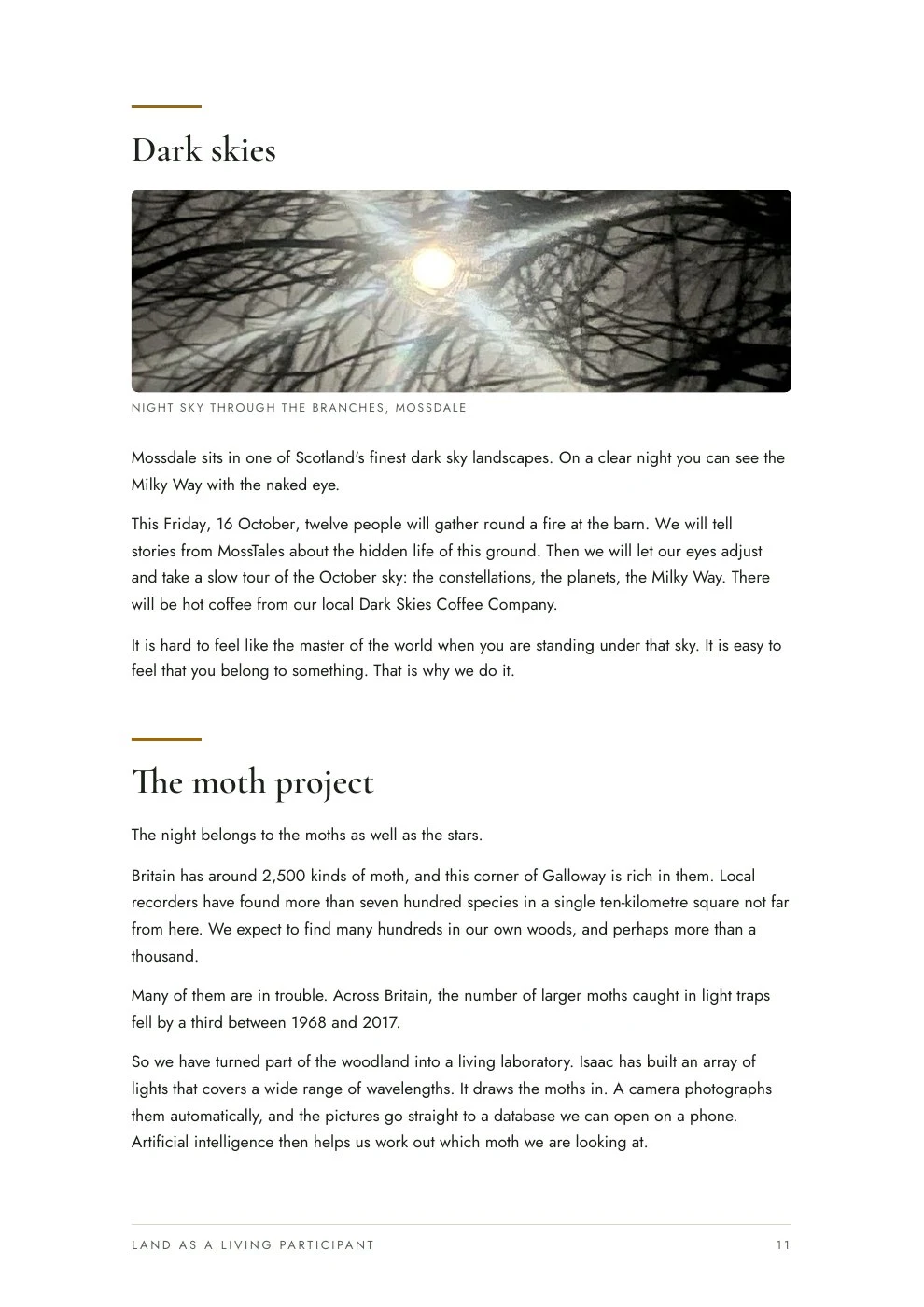
NIGHT SK Y THROUGH THE BRANCHES, MOSSDALE
Mossdale sits in one of Scotland's finest dark sky landscapes. On a clear night you can see the Milky Way with the naked eye. This Friday, 16 October, twelve people will gather round a fire at the barn. We will tell stories from MossTales about the hidden life of this ground. Then we will let our eyes adjust and take a slow tour of the October sky: the constellations, the planets, the Milky Way. There will be hot coffee from our local Dark Skies Coffee Company. It is hard to feel like the master of the world when you are standing under that sky. It is easy to feel that you belong to something. That is why we do it.
The moth project The night belongs to the moths as well as the stars. Britain has around 2,500 kinds of moth, and this corner of Galloway is rich in them. Local recorders have found more than seven hundred species in a single ten-kilometre square not far from here. We expect to find many hundreds in our own woods, and perhaps more than a thousand. Many of them are in trouble. Across Britain, the number of larger moths caught in light traps fell by a third between 1968 and 2017. So we have turned part of the woodland into a living laboratory. Isaac has built an array of lights that covers a wide range of wavelengths. It draws the moths in. A camera photographs them automatically, and the pictures go straight to a database we can open on a phone. Artificial intelligence then helps us work out which moth we are looking at.
L A N D A S A L I V I N G PA R T I C I PA N T
11
Read page 12 as text
It is a tool, and it helps us to see more. People learn the names and notice what changes. And the wood tells us, night by night, who is living here.
The cards The oldest tool in this work is a set of cards. I have used and tested the Naturally Smart cards with communities for twenty years. Everything else was added later. They work like this. A group is given the cards. They talk, and they lay the cards out on the table to tell the story of their place: its water, its food, its energy, its shelter, its people. Then they use the same cards to plan. Communities do not need layer upon layer of technical data. They need a way to talk to each other about where they live. The cards give them a broad set of things to consider and leave every choice in their hands. The cards are also not only about people. Transport includes bird migration and deer runs. Shelter includes nests under the eaves and rabbit holes. The land and its other creatures are at the table too. Other decks have grown from the same root. The Breathe cards and the Elemental cards carry the seasonal reflections into the hand, one small noticing at a time. The Hermitary holds thirtysix figures from twenty-five centuries who turned aside from the world's noise to pay attention. You draw one each morning and carry that person through the day.
What we are seeing
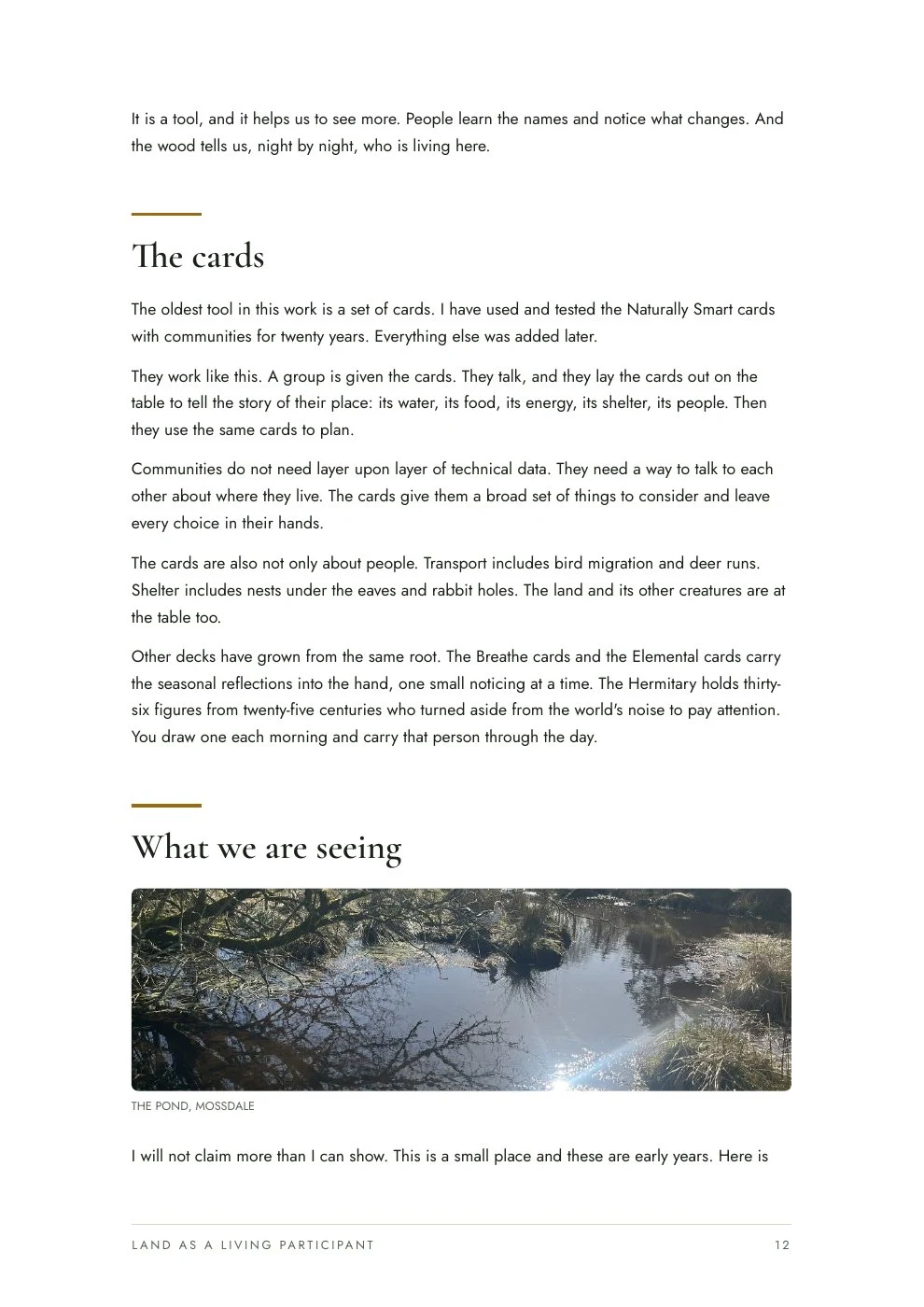
THE POND, MOSSDALE
I will not claim more than I can show. This is a small place and these are early years. Here is
L A N D A S A L I V I N G PA R T I C I PA N T
12
Read page 13 as text
what I can say. People come back. They come back in winter, in the dark and in the rain. People who had little to do with each other now grow, cook, mend and plan together. A village that could easily have been written off has a plan for its hall and a growing sense of what it is for. People tell us that ordinary things look different afterwards. The hawthorn outside the kitchen window stops being background. The pigeon on the fence becomes that particular bird. It sounds small. It is where care begins, because you do not destroy what you have truly noticed. People who arrive tired often leave lighter. I do not measure that, and I will not turn it into a score. Water quality can be measured. Money must be accounted for. A person's sense of belonging should be left in peace.
The Clearing, and an invitation This work has travelled for years, and it is still travelling. In December we will hold The Clearing in Jiazi, in China: seven days for people who lead ecological communities, built on the same practices of sitting, sensing and returning. A team there has been doing related work for two years, and we are learning from each other. Naturally Smart Group CIC works in partnership with the World Ecological Civilization Community Foundation to share it further. Nothing here is difficult or expensive. It can begin wherever you are. 1. Find a place and go back to it. Sit. Walk slowly. Light a fire if you can. 2. Bring others, and do not make them talk. Let people speak in their own words when they are ready. 3. Tell the stories of your own ground. Mark the turning of your own year. 4. Make something together. Use your hands and what the land gives you: a meal, a shelter, a song, a story. 5. Bring it to a real decision. Ask what the land would need from a new building, a field or a water supply. Then act on the answer. So here is my invitation. Come to Mossdale. Sit at the fire. Put your feet in the ground. Then go home, begin where you are, and tell us what your land teaches you.
L A N D A S A L I V I N G PA R T I C I PA N T
13
Read page 14 as text
Take a breath. Take a moment. Be still and enjoy the world we have right now. Then take care, and begin to play a part in making sure it stays that way.
With thanks
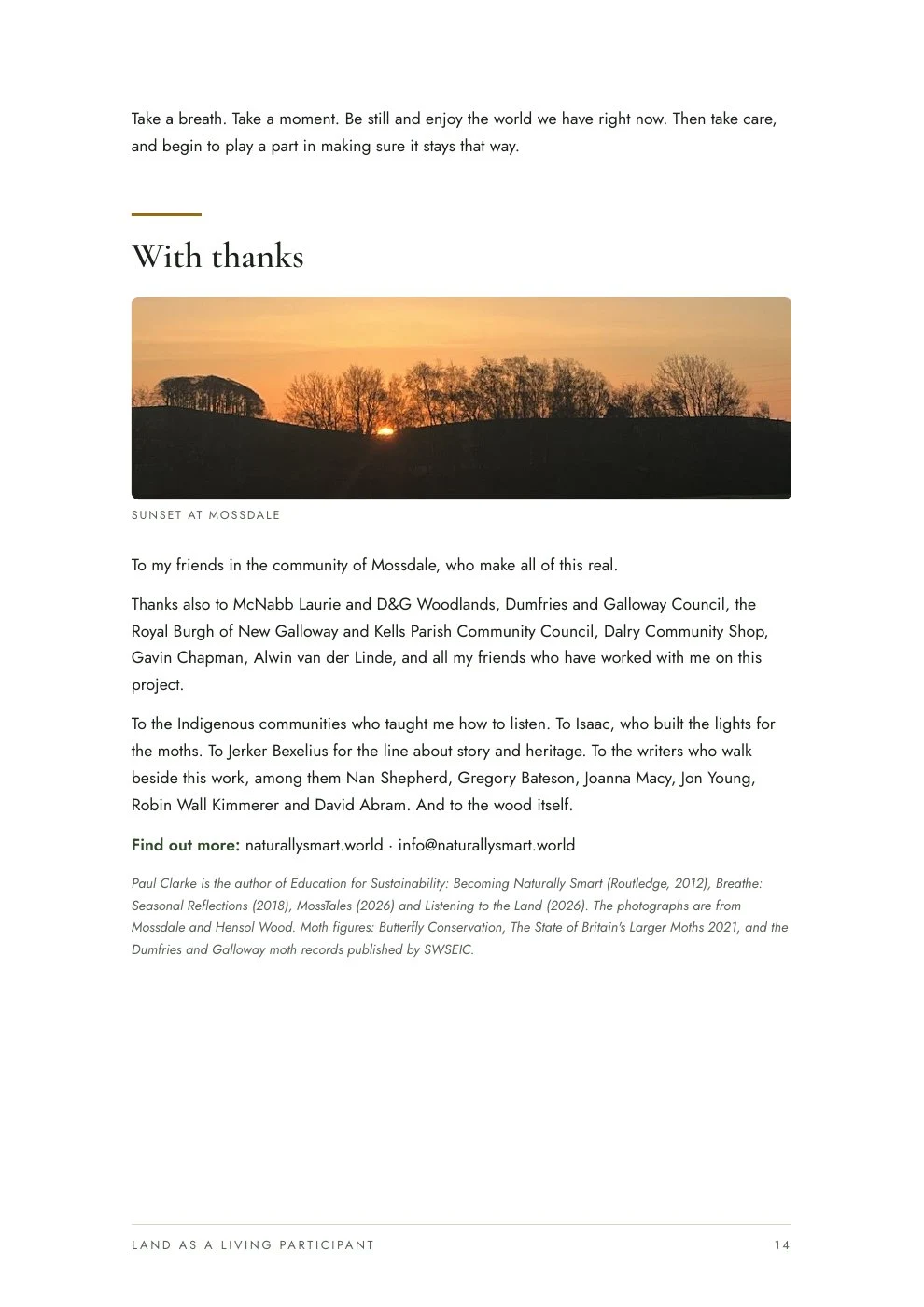
S U N S E T AT M O S S D A L E
To my friends in the community of Mossdale, who make all of this real. Thanks also to McNabb Laurie and D&G Woodlands, Dumfries and Galloway Council, the Royal Burgh of New Galloway and Kells Parish Community Council, Dalry Community Shop, Gavin Chapman, Alwin van der Linde, and all my friends who have worked with me on this project. To the Indigenous communities who taught me how to listen. To Isaac, who built the lights for the moths. To Jerker Bexelius for the line about story and heritage. To the writers who walk beside this work, among them Nan Shepherd, Gregory Bateson, Joanna Macy, Jon Young, Robin Wall Kimmerer and David Abram. And to the wood itself. Find out more: naturallysmart.world · info@naturallysmart.world Paul Clarke is the author of Education for Sustainability: Becoming Naturally Smart (Routledge, 2012), Breathe: Seasonal Reflections (2018), MossTales (2026) and Listening to the Land (2026). The photographs are from Mossdale and Hensol Wood. Moth figures: Butterfly Conservation, The State of Britain's Larger Moths 2021, and the Dumfries and Galloway moth records published by SWSEIC.
L A N D A S A L I V I N G PA R T I C I PA N T
14